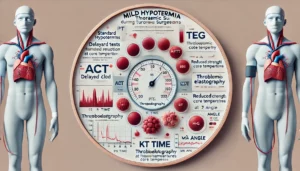


TEG Results 2024

Temperature Effect on Coagulation Function in Mild Hypothermic Patients Undergoing Thoracic Surgeries: Thromboelastography (TEG) Versus Standard Tests

This study compared coagulation monitoring methods in mild hypothermic patients during thoracic surgery. Thromboelastography (TEG) detected significant coagulation impairments, including delayed clot formation and reduced clot strength, which standard tests failed to reveal. Temperature-adjusted TEG showed worse coagulation function at core hypothermic temperatures. Findings suggest TEG’s superiority for hemostatic monitoring and transfusion guidance in hypothermic surgical patients.

Read More »
Goal Direct Perfusion

Efficacy of Goal-Directed Versus Preemptive Tranexamic Acid Administration in Cardiovascular Surgery: The GDT Trial

The GDT trial compares goal-directed tranexamic acid (TXA) administration guided by rotational thromboelastometry (ROTEM) to preemptive TXA administration in cardiovascular surgery. This multi-center, double-blind, randomized trial aims to determine non-inferiority in reducing postoperative bleeding. Secondary outcomes include transfusion rates, thromboembolic complications, seizures, and hospital costs. The study hypothesizes that selective TXA administration will lower adverse events compared to preemptive dosing.

Read More »
Bivalirudin ECMO

Prospective Randomized Pilot Study Comparing Bivalirudin Versus Heparin in Pediatric ECMO

This pilot randomized controlled trial compared bivalirudin and unfractionated heparin for anticoagulation in 30 pediatric ECMO patients. No difference was found in time at goal anticoagulation, the primary endpoint. However, bivalirudin was associated with higher thrombotic complications (37.5% vs. 0%; p=0.02) but required fewer RBC transfusions (median 6.3 vs. 12.2 mL/kg/day; p=0.02). The study demonstrates feasibility for larger trials to evaluate the safety and efficacy of bivalirudin in pediatric ECMO.

Read More »
Protamine 101

Platelet Function Is Preserved After Moderate Cardiopulmonary Bypass Times But Transiently Impaired After Protamine

This study assessed platelet function and numbers in 39 patients undergoing coronary artery bypass surgery with cardiopulmonary bypass (CPB). Platelet function was measured at six different points, including after protamine administration. Results showed no significant impairment of platelet function during CPB. However, platelet function was temporarily reduced after protamine but recovered within 3 hours post-surgery.

Read More »
Thromboembolic Complications ECMO

Thromboembolic Complications in Continuous Versus Interrupted Anticoagulation During Venovenous Extracorporeal Membrane Oxygenation: A Multicenter Study

This study investigates thromboembolic complications in patients undergoing venovenous extracorporeal membrane oxygenation (ECMO) with continuous versus interrupted anticoagulation. Data from 346 patients across three ECMO centers were analyzed. Results showed no significant difference in thrombotic complications between the groups, although interruptions in anticoagulation were linked to increased thrombotic events as the frequency and duration of interruptions rose.

Read More »
Blood Hero

Methodologic Quality and Pharmacotherapy Recommendations for Patient Blood Management Guidelines for Cardiac Surgery on Cardiopulmonary Bypass

This study evaluates the methodological quality and pharmacotherapy recommendations of Patient Blood Management (PBM) guidelines for cardiac surgery involving cardiopulmonary bypass (CPB). Analyzing guidelines using the AGREE II tool, it highlights varying consistency across documents, especially in stakeholder involvement. The study reviews drug therapy strategies including anemia therapy, perioperative antithrombotic administration, intraoperative anticoagulation, and hemostatic drug use, noting a lack of pediatric-specific evidence and the cautious use of certain drugs post-surgery.

Read More »
Heparin Vs.

Comparison of Bivalirudin Versus Heparin for Anticoagulation During Extracorporeal Membrane Oxygenation

This systematic review and meta-analysis evaluated the efficacy and safety of bivalirudin compared to heparin in patients undergoing extracorporeal membrane oxygenation (ECMO). After reviewing eleven studies focusing on short-term mortality, findings revealed that bivalirudin is associated with significantly lower short-term mortality than heparin, with an odds ratio of 0.71. This suggests bivalirudin may be a preferable anticoagulant for patients on ECMO, though further prospective research is needed to confirm these results.

Read More »
Heparin

Comparison of Blood Concentration and Weight-Based Heparin and Protamine Dosing Strategies for Cardiopulmonary Bypass: A Systematic Review and Meta-Analysis

This article reviews randomized controlled trials and prospective studies comparing individualized heparin and protamine dosing based on real-time blood heparin concentration versus traditional total body weight methods during cardiopulmonary bypass (CPB). Meta-analysis shows that individualized dosing significantly reduces postoperative blood loss, improves protamine-to-heparin ratios, and increases early postoperative platelet counts. These findings suggest that precision in heparin and protamine dosing could decrease bleeding and transfusion needs, highlighting the potential of machine learning for future advancements in anticoagulation management for CPB.

Read More »