A Prospective Observational Study on Role of Intraoperative Renal & Muscle Oxygen Saturation on Post-Operative Serum Creatinine Level in Patients Undergoing Cardiac Surgery on Cardiopulmonary Bypass
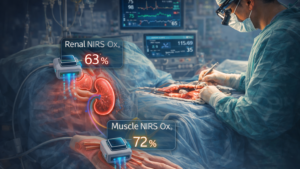
This prospective observational study evaluated whether intraoperative renal (SrO₂) and thenar muscle oxygen saturation (SmO₂), measured using near-infrared spectroscopy (NIRS), could predict post-operative increases in serum creatinine in patients undergoing cardiac surgery with cardiopulmonary bypass. Among 55 patients, a >20% decrease in renal oxygen saturation strongly predicted post-operative creatinine rise, while a 15% decrease in muscle oxygen saturation also showed strong predictive value. Both parameters were significantly correlated.